
The Secret Behind 16-Hour Wear: Is Your Makeup Fixer Silently Ruining Your Skin?
You have spent forty-five minutes carefully sculpting, blending, and baking your complexion into a seamless masterpiece. Your foundation is seamless, your contour is razor-sharp, and your highlight catches the light at every correct angle. Fast-forward three hours into a night out or a high-stakes workday: you catch a glance in the bathroom mirror and disaster has struck. Your foundation has separated around your nose, your concealer is settling into fine lines, and your blush seems to have vanished into thin air.
Why does this happen even when you use expensive primers and high-end cosmetics?
The culprit is almost never your foundation or your application technique. The real weak link in your routine is likely an omitted or misunderstood final step: the makeup fixer. Often confused with standard setting sprays, a true makeup fixer is the single most powerful product in professional beauty kits. But how does this invisible mist actually work? Is it safe for daily use? And could the way you apply it actually be destroying your makeup instead of saving it?
Here is the truth behind makeup fixers, the science of how they operate, and the exact steps to turn your face into a transfer-proof canvas.
What Exactly Is a Makeup Fixer?
At its core, a makeup fixer (often referred to as a fixing spray) is a top-coat liquid formulation applied via a micro-fine mist. While cosmetics are made up of dynamic mixtures of oils, waxes, pigments, and powders, external factors like heat, sebum production, moisture, and friction constantly work to break those ingredients down.
A makeup fixer forms an elastic, invisible, and weightless barrier over all those layers. It fuses the separate elements of your makeup—from liquid concealers to dry setting powders—and glues them down to your skin cells, creating a unified shield that resists melting, cracking, or smudging.
The Great Industry Confusion: Fixing Spray vs. Setting Spray
The beauty industry frequently uses the terms “setting spray” and “fixing spray” interchangeably, leading to widespread confusion. However, from a chemical perspective, they are two distinctly different products engineered for two completely different goals.
| Feature | Setting Spray (Finishing Spray) | Makeup Fixer (Fixing Spray) |
| Primary Function | Melts powders together for a natural, skin-like finish. | Locks makeup down for extreme, transfer-proof longevity. |
| Core Base | Water, humectants (glycerin), botanicals, and light oils. | Polymers, resins, solvents, and film-formers. |
| Finish | Dewy, hydrated, or soft velvet finish. | Matte, semi-matte, or bulletproof shield. |
| Best Used For | Daily wear, eliminating a cakey or powdery look. | Events, hot humid weather, theater, and 12+ hour wear. |
Understanding this distinction is vital. If you spritz a hydrating setting spray expecting it to stop your makeup from rubbing off on your clothes during a humid summer wedding, you will be disappointed. Conversely, if you apply a heavy-duty makeup fixer every morning on ultra-dry skin without proper prep, you might experience tightness or irritation.
The Chemistry Behind the Shield: How It Works
How can a water-like liquid spray prevent pigmented powders and creams from transferring? The magic lies in polymer chemistry.
- Film-Forming Polymers: The workhorses of any makeup fixer are synthetic polymers such as PVP (Polyvinylpyrrolidone), Acrylates Copolymer, or AMP-Acrylates. When misted onto the face, the liquid solvent evaporates quickly. As it dries, these microscopic long-chain molecules bind together, drying down into a flexible, continuous film over the skin.
- Surface Tension Reduction: Powder particles sit unevenly on top of skin hairs and texture. A fine fixer mist dissolves the sharp edges of these powders, drawing them flat against the base layers.
- Hydrophobic Seals: Many fixers incorporate silicone derivatives or mild alcohol networks that repel environmental moisture. Sweat bead drops sit on top of the film rather than penetrating the foundation underneath.
Key Ingredients: The Good, The Bad, and The Essential
When shopping for a makeup fixer, reading the ingredient label helps ensure you choose the right formula for your skin.
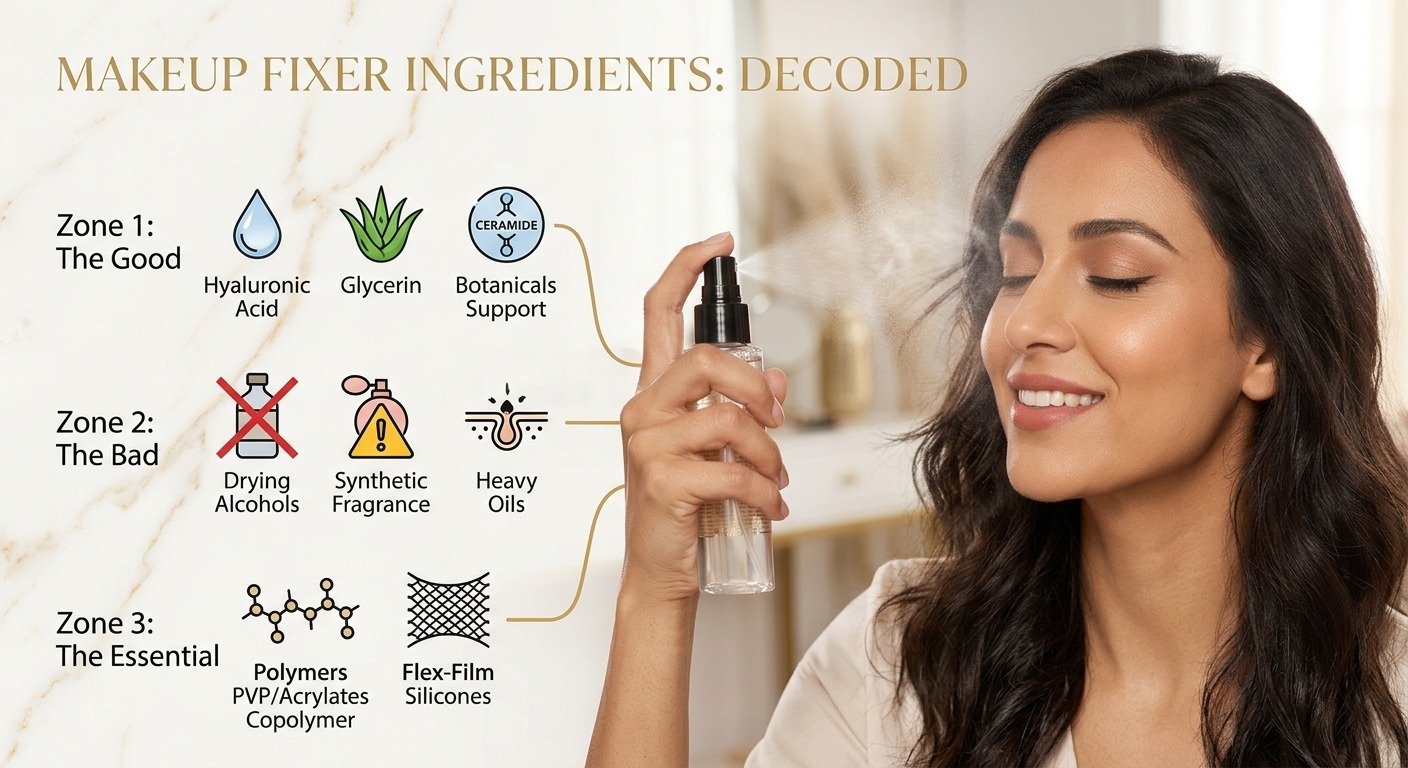
The Functional Heroes
- PVP/Acrylates Copolymer: The primary film-forming agents responsible for long wear.
- Niacinamide: Calms the skin, reduces redness, and balances oil production throughout the day.
- Hyaluronic Acid & Glycerin: Humectants added to balance out intense polymers so the skin stays hydrated underneath the shield.
- Botanical Extracts (Green Tea, Chamomile, Rose Water): Provide antioxidant protection against urban pollution and soothe inflammation.
Ingredients to Monitor
- Denatured Alcohol (Alcohol Denat.): Alcohol allows the formula to evaporate almost instantly and creates a solid, matte seal. While essential for oil control and maximum longevity, frequent use of high-alcohol fixers can disrupt the skin barrier, leading to dryness or rebound oil production.
- Heavy Fragrances: Synthetic fragrances can cause irritation when trapped under a film-forming layer, especially on sensitive or eczema-prone skin.
Step-by-Step: The Professional Application Method
Applying a makeup fixer seems straightforward, but minor mistakes can leave water spots, dissolve your foundation, or create uneven patches. Follow this master technique used by editorial makeup artists.
Step 1: Prep & Prime ➔ Step 2: Layer Base ➔ Step 3: Shake & Position ➔ Step 4: The X+T Method ➔ Step 5: Air-Dry Lock
1. Prep and Prime
Long-lasting makeup starts with skin preparation. Apply your hydrating moisturizer and a targeted primer (hydrating for dry skin, pore-blurring or mattifying for oily skin).
2. Apply Your Base
Complete your full routine—foundation, concealer, cream contour, setting powder, blush, and brows. Pro-tip: Hold off on mascara and liquid eyeliner until after fixing, as mist can cause fresh mascara to bleed.
3. Shake and Position
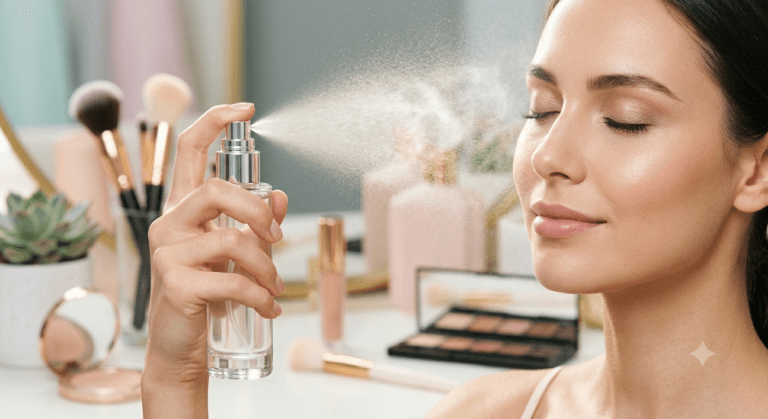
Shake the bottle vigorously for 5 to 10 seconds to combine settled polymers and active ingredients. Hold the bottle 8 to 10 inches away from your face. Holding it too close creates large droplets that can dissolve pigment, while holding it too far causes the mist to evaporate before reaching your skin.
4. The “X” and “T” Method
Close your eyes and mouth completely. Mist your face in a sweeping movement forming an “X” pattern, followed immediately by a “T” pattern. This guarantees even coverage across the forehead, nose, cheeks, and jawline. 2 to 4 full pumps are usually sufficient.
5. Air-Dry Completely
Do not pat, wipe, fan aggressively, or blend the mist while it is wet. Allow the fixer to air-dry naturally over 60 seconds. As the liquid evaporates, the film hardens into its final protective matrix. Once dry, finish with your mascara and lip gloss.
Pro Tricks: Beyond the Final Spritz
Professional makeup artists rarely reserve makeup fixers solely for the final step. Here are industry hacks to maximize performance:
- The Beauty Sponge Trick: Before blending your foundation or concealer, dampen your beauty sponge with a few sprays of makeup fixer. Pressing the foundation into the skin with polymer-infused moisture locks the pigment directly to the skin cells from the first layer.
- Intensifying Eyeshadow Pigment: Spritz your eyeshadow brush with a makeup fixer after picking up a shimmer, metallic, or foil shadow. This dampens the pigment, preventing fallout, while turning powder into a liquid foil finish that won’t crease.
- The “Powder Sandwich” Method: For ultra-oily skin or extreme humidity, apply a light dusting of translucent powder immediately after primer, spritz with fixer, allow it to dry, apply foundation, and spritz with fixer once more. This creates a double barrier that absorbs oil from beneath while blocking sweat from above.
Choosing the Right Fixer for Your Skin Type
Using the wrong formula can lead to uncomfortable tightness or unexpected shine. Match your fixer to your skin profile:
Oily / Acne-Prone Skin
- Look For: Oil-free, mattifying formulas with ingredients like charcoal, kaolin clay, silica, or niacinamide.
- Avoid: Formulas heavy in botanical oils (like coconut or jojoba oil) or excessive glycerin.
- Goal: Control sebum build-up and eliminate midday shine without breaking out.
Dry / Dehydrated Skin
- Look For: Alcohol-free or low-alcohol fixers infused with hyaluronic acid, aloe vera, or vitamin E.
- Avoid: High-proof denatured alcohol bases that strip residual moisture.
- Goal: Lock in makeup without settling into dry patches or causing flaking.
Combination Skin
- Look For: Balanced, natural-finish fixers.
- Pro Hack: Use a hydrating setting spray all over, then lightly mist a heavy-duty fixer strictly on your T-zone (forehead, nose, chin).
Sensitive Skin
- Look For: Fragrance-free, hypoallergenic, alcohol-free formulas containing chamomile or centella asiatica.
- Goal: Extend wear without triggering contact dermatitis or flare-ups.
Is Your Makeup Fixer Silently Ruining Your Skin?
Despite their benefits, makeup fixers are powerful formulations. Because they create an impenetrable film over the skin, they can trap sweat, dead skin cells, environmental pollutants, and natural sebum beneath that matrix.
If you use high-strength, alcohol-based fixers daily without updating your night routine, you may experience clogged pores, micro-comedones, or skin dehydration.
How to Protect Your Skin Barrier:
- Double Cleanse at Night: Water alone or a mild face wash will not break down film-forming polymers effectively. Use an oil-based cleanser or micellar water first to dissolve the fixer barrier, followed by a gentle foaming cleanser.
- Reserve High-Alcohol Fixers for Special Occasions: Use lightweight, hydrating setting mists for everyday errands, and keep heavy-duty fixers for events, long photo shoots, or nights out.
- Prioritize Nighttime Hydration: When using fixers frequently, support your skin barrier at night with ceramide-rich moisturizers and repairing serums.
Common Mistakes That Ruin Your Look
Avoid these frequent mistakes when using a makeup fixer:
- Spraying Too Close: Results in heavy liquid drops that run down your face, creating visible streaks in your foundation.
- Rubbing or Dabbing While Wet: Touching your face while the polymers are bonding disrupts the matrix, pulling your foundation off in patches.
- Using It as a Primer Replacement: Fixers are designed to seal over products, not adhere to bare skin. Always start with dedicated skincare and primer.
- Over-Spraying: Soaking your face in fixer does not make it last twice as long; it simply over-saturates powder layers and causes your makeup to slide.
Final Verdict: Is It Worth the Vanity Space?
If you have ever suffered from foundation transferring onto your clothes, makeup disappearing mid-day, or makeup melting in high heat, a dedicated makeup fixer is a game-changing addition to your beauty arsenal.
By selecting a formula tailored to your skin type and mastering the proper technique, you can lock in your makeup with confidence, knowing your look will remain fresh and vibrant for hours.
Makeup Fixers (Heavy-Duty Lock & Transfer-Proof)
| Product Name | Tier | Standard Size | Retail Price Range | Finish | Key Feature |
| ONE/SIZE On ‘Til Dawn Mattifying Mist | Mid-Prestige | 3.4 oz / 100 ml | $32 – $34 | Extreme Matte | Waterproof aerosol fixer film |
| Urban Decay All Nighter Fixing Spray | Mid-Prestige | 4.0 oz / 118 ml | $33 – $36 | Natural / Satin | Industry benchmark for 16-hr wear |
| Skindinavia The Makeup Finishing Spray | Professional | 4.0 oz / 118 ml | $30 – $32 | Natural | Temperature control fixing technology |
| L’Oréal Paris Infallible 3-Second Setting Mist | Drugstore | 2.5 oz / 75 ml | $11 – $14 | Soft Matte | High-performing aerosol fixer dupe |
| Kryolan Dermacolor Fixing Spray | Pro / SFX | 5.0 oz / 150 ml | $28 – $35 | Matte | Extreme theater-grade waterproofing |
Setting Sprays (Melting, Blending & Skin-Finish)
| Product Name | Tier | Standard Size | Retail Price Range | Finish | Key Feature |
| Charlotte Tilbury Airbrush Flawless | Luxury | 3.4 oz / 100 ml | $38 – $40 | Soft Focus / Dewy | Pore-blurring hydrating formula |
| MAC Prep + Prime Fix+ | Prestige | 3.4 oz / 100 ml | $30 – $33 | Dewy / Natural | Botanical blend to melt powder layers |
| Morphe Continuous Setting Mist | Mid-Range | 2.7 oz / 79 ml | $16 – $18 | Radiant | Fine aerosol micro-mist |
| Milani Make It Last 3-in-1 Spray | Drugstore | 2.0 oz / 60 ml | $10 – $12 | Natural | Top-rated budget powder melter |
| NYX Professional Matte / Dewy Spray | Drugstore | 2.0 oz / 60 ml | $9 – $10 | Matte or Dewy | Best entry-level daily setting spray |
| e.l.f. Cosmetics Stay All Night Mist | Budget | 2.7 oz / 80 ml | $10 – $11 | Natural | Fine mist value pick |
Key Price Breakdown Insights
- Budget / Drugstore Tier ($8 – $15): Focuses on everyday wear (6–8 hours). Ideal for eliminating cakey powder texture without spending heavily.
- Mid-Range / Prestige Tier ($16 – $36): Features film-forming polymers for high heat, sweat, and long event wear (12–16 hours).
- Luxury Tier ($38+): Combines fixing polymers with high-end skincare ingredients (like niacinamide, antioxidants, and fine blurring powders).
Q1: What is the main difference between a setting spray and a makeup fixer?
<468>A: A setting spray is water- or humectant-based and melts powder and liquid makeup layers together for a seamless, hydrated finish.</468> <469>A makeup fixer uses film-forming polymers and alcohols to create an impenetrable, transfer-proof shield that locks cosmetics in place for 12 to 16+ hours.</469>
Q2: Should you apply makeup fixer before or after mascara?
A: Always apply makeup fixer before mascara and liquid eyeliner. The liquid mist from the fixer can soften fresh water-soluble mascara, causing it to run or smudge under the eyes. <470>Finish your base, brow, and powder products, apply fixer, let it dry completely, and apply mascara last.</470>
Q3: Can using a makeup fixer every day cause acne or breakouts?
<471>A: Daily use of heavy-duty makeup fixers can trap sebum, bacteria, and dead skin cells beneath its polymer film, potentially causing clogged pores.</471> To prevent breakouts, perform a thorough double-cleanse using an oil-based cleanser at night to dissolve the water-resistant seal.
Q4: How far away should you hold a fixing spray when applying?
<472>A: Hold the bottle 8 to 10 inches (20–25 cm) away from your face.</472> Spraying too close creates large droplets that can dissolve your foundation, while spraying too far causes the fine mist to evaporate before reaching your skin.
Q5: Is makeup fixer suitable for dry skin?
<473>A: Yes, provided you choose an alcohol-free or hydrating makeup fixer containing humectants like hyaluronic acid, glycerin, or aloe vera.</473> Avoid high-proof denatured alcohol formulas, which strip natural oils and emphasize dry patches.
Q6: Why is my foundation separating even after using a fixing spray?
A: Foundation separation typically occurs when you spray fixer on wet base layers or touch your skin before the mist dries. <474>Allow your foundation and setting powders to settle first, mist using an “X” and “T” motion, and let the spray air-dry untouched for 60 seconds.</474>