Guide to Retinol Serum: Benefits, Side Effects, and How to Use It for Flawless Skin
The Ultimate Guide to Retinol Serum: Science, Benefits, and How to Use the Gold Standard of Skincare
Few ingredients in the vast world of skincare have achieved the legendary, universally universally backed status of retinol. If you have ever asked a dermatologist for a single product to target aging, fine lines, dark spots, or acne, chances are their immediate answer was a retinol serum.
But what exactly is this liquid gold, how does it work on a microscopic level, and why does it have a reputation for being both a miracle worker and a bit of a diva to work with?
This comprehensive guide breaks down the science, benefits, potential side effects, and exact application methods of retinol serum so you can unlock radiant, youthful skin safely and effectively.
What is Retinol Serum?
Retinol is a derivative of Vitamin A, belonging to a family of compounds known as retinoids. While it has been used in dermatological treatments since the 1970s—originally as a powerhouse tool to combat severe acne—researchers quickly noticed an incredible side effect: patients using it were developing smoother, firmer, and visibly brighter skinhttps://glowingcave.com/2026/07/12/the-ultimate-guide-to-a-holistic-beauty-routine-clean-skincare-wellness/.
When you apply an over-the-counter retinol serum to your skin, it doesn’t immediately go to work. Instead, specialized enzymes within your skin cells must first convert the retinol into retinoic acid. Once it becomes retinoic acid, it binds directly to the nuclear receptors in your skin cells, instructing them to behave like younger, healthier cells.
The Retinoid Family Tree
To choose the right serum, it helps to understand where your product sits on the potency spectrum. The fewer conversion steps required to reach retinoic acid, the stronger the product (and the higher the chance of initial irritation):
- Retinyl Palmitate: Requires three conversion steps. Extremely gentle, ideal for hyper-sensitive skin or the delicate eye area.
- Retinol: Requires two conversion steps. This is the most common over-the-counter standard, providing an excellent balance between structural efficacy and skin tolerance.
- Retinaldehyde (Retinal): Requires only one conversion step. It works up to 11 times faster than standard retinol, making it a favorite for advanced skincare users.
- Pure Retinoic Acid (Tretinoin): Zero conversion steps. This is a prescription-only formulation (often sold under names like Retin-A) that is incredibly potent and used for severe acne and deep structural anti-aging.
How Retinol Works: The Biological Magic
Most cosmetic ingredients act as humectants or barriers; they sit on top of the skin, pulling in moisture or trapping it to give a temporary plumping effect. Retinol operates completely differently. Because it is fat-soluble (lipophilic), it easily penetrates the outer protective layer of your skin (the stratum corneum) to reach the deeper structural layers.
Once active, it triggers two major biological transformations:
1. Accelerating Cellular Turnover
Naturally, your skin generates new cells at its base layer, which slowly migrate to the surface over a cycle of roughly 28 days. As we cross the age of 25, this cycle slows down significantly, stretching to 40 or even 60 days. This slow cell turnover leaves old, dry, damaged cells sitting on the surface, causing a dull complexion, clogged pores, and accentuated fine lines.
Retinol acts as a fast-forward button. It forces the skin to shed those dead surface cells rapidly, replacing them with fresh, beautifully organized cells underneath.
2. Boosting Collagen and Elastin Production
Collagen is the structural scaffolding that keeps our skin bouncy and firm. Unfortunately, our natural collagen production drops by roughly 1% every single year after we turn 25. Retinol stops this decline in its tracks. It not only signalshttps://www.amazon.com/s?k=serum+for+face&adgrpid=81891244752&hvadid=673501728620&hvdev=c&hvlocphy=9223217&hvnetw=g&hvqmt=e&hvrand=10565216513332512443&hvtargid=kwd-2105294495&hydadcr=22336_13507798&mcid=e9d6f1735abb3074a1f786af1eed51dd&tag=hydglogoo-20&ref=pd_sl_2e6vd3yvnj_e your fibroblasts (the cells responsible for collagen) to ramp up production, but it also actively inhibits the enzymes (metalloproteinases) that destroy your existing collagen.
Top 5 Benefits of Using Retinol Serum
Whether your skin goal is preventative aging or clearing up persistent blemishes, a retinol serum offers broad-spectrum solutions.
1. Erasing Fine Lines and Deeper Wrinkles
By thickening the deeper layers of the epidermis and stimulating type-1 collagen production, retinol acts as an internal filler. With consistent use, the structural depressions that cause fine lines—especially around the eyes and mouth—are gradually smoothed over from the inside out.
2. Clearing Acne and Shrinking Large Pores
Acne forms when micro-comedones are created by dead skin cells mixing with excess sebum (oil) inside a pore. Because retinol accelerates exfoliation and keeps skin cells moving, it stops these plugs from forming in the first place. As a secondary benefit, keeping pores clear of debris allows them to shrink back to their natural size, resulting in a drastically smoother facial texture.
3. Fading Hyperpigmentation and Sun Spots
Whether you are dealing with melasma, sun damage, or post-inflammatory hyperpigmentation (the dark marks left behind by healed acne), retinol can help. By speeding up the shedding of melanin-dense surface cells and regulating the cells that produce pigment (melanocytes), it unifies your skin tone and restores natural radiance.
4. Improving Skin Texture and Elasticity
Clinical trials show that regular application of retinol vastly improves the overall elasticity and rough texture of mature skin. It optimizes the moisture barrier, reducing transepidermal water loss (TEWL) over time by correcting the overall cellular organization of the skin’s surface.
5. Enhancing the Efficacy of Other Skincare
When your skin is coated in a layer of dead, un-exfoliated cells, your expensive humectants, peptides, and vitamin C serums struggle to penetrate. By clearing out this cellular roadblock, retinol enables the rest of your morning and evening skincare routine to penetrate deeper and perform significantly better.
The Side Effects: Managing the “Retinol Purge”
Because retinol fundamentally alters how your skin functions, your tissue goes through an acclimation phase known as retinization. During the first 2 to 6 weeks of use, you may experience temporary side effects:
- Dryness and Flaking: As old skin sheds rapidly, you may notice peeling around the nose and mouth.
- Mild Redness and Irritation: A slight stinging or warm sensation as the skin barrier adjusts.
- The Purge: If you have underlying blockages deep in your pores, retinol will pull them to the surface all at once. This can cause a temporary flare-up of breakouts.
Important Note: Purging is completely normal and is a sign that the product is working. A true purge should last no longer than 4 to 6 weeks. If your skin remains highly inflamed, raw, or painful beyond this mark, reduce your frequency or switch to a lower concentration.
How to Apply Retinol Serum: The Step-by-Step Protocol
To maximize your results while minimizing irritation, structure your application exactly using a precise evening procedure.
1
Double Cleanse
Nighttime Only
1.Double Cleanse:Nighttime Only.
Wash your face with a gentle, sulfate-free cleanser to remove makeup, SPF, and pollution. Pat your face completely dry with a clean towel.
2
Wait for Complete Dryness
Crucial 5-Minute Pause
2.Wait for Complete Dryness:Crucial 5-Minute Pause.
Never apply retinol to damp skin. Water on the skin surface accelerates the absorption of retinol, pulling it too deeply and too quickly, which causes intense irritation and peeling. Wait 5 full minutes until your skin is totally dry.
3
Apply a Pea-Sized Amount
Less is More
3.Apply a Pea-Sized Amount:Less is More.
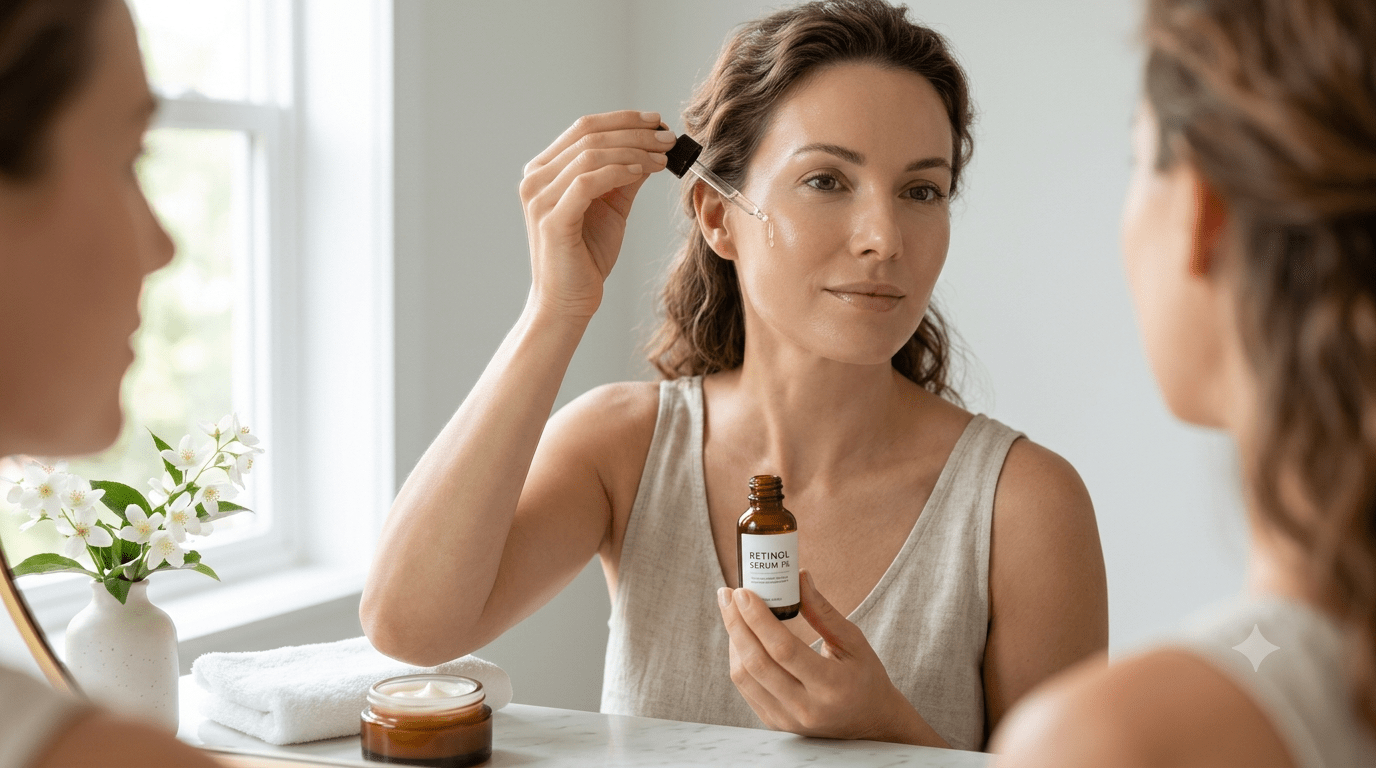
Dispense a single pea-sized drop of retinol serum onto your index finger. Dot it onto your forehead, cheeks, and chin, then gently smooth it across your face, avoiding the immediate eyelids and lips.
4
Lock it In with Moisturizer
Barrier Protection
4.Lock it In with Moisturizer:Barrier Protection.
Wait 2 to 3 minutes for the serum to absorb, then apply a rich, ceramide-heavy moisturizer to soothe the skin barrier and prevent dryness overnight.
Advanced Method: The “Sandwich Technique” for Sensitive Skin
If you have highly sensitive skin, dry skin, or are terrified of flaking, use the Sandwich Technique. This involves applying a thin layer of basic moisturizer first, applying your pea-sized drop of retinol directly over it, and then sealing it with a second layer of moisturizer.
This acts as a structural buffer, slowing down the rate of penetration without rendering the retinol ineffective, making the process incredibly comfortable for beginners.
Retinol Golden Rules and Pitfalls to Avoid
To ensure your journey with vitamin A is successful, commit these critical rules to memory:
- Only Use it at Night: Retinol is highly photosensitive and degrades quickly when exposed to direct sunlight, making it useless during the day.
- Wear SPF 30+ Every Single Morning: Because retinol brings fresh, new baby skin cells to the surface, your face becomes significantly more susceptible to UV sun damage. Skipping sunscreen while using retinol can actually worsen dark spots and aging.
- Avoid Mixing Active Ingredients: Do not use your retinol serum in the same evening routine as exfoliating acids like AHA/BHA (glycolic, lactic, or salicylic acid) or Vitamin C. Instead, use Vitamin C in the morning, and alternate your nights between exfoliating acids and retinol.
- Be Patient: Skincare is a marathon, not a sprint. While initial surface texture improvements can appear in 4 to 6 weeks, true structural improvements in fine lines and collagen density require 3 to 6 months of dedicated, consistent use.
Final Thoughts: Finding Your Perfect Match
Retinol serum remains the undisputed champion of the anti-aging skincare world for a clear reason: it works. By choosing the right formulation for your skin type, starting slowly (twice a week to begin with), protecting your skin barrier with moisture, and committing to daily sun protection, you can rewrite your skin’s future.
Be patient through the initial adjustment phase, and your skin will reward you with unparalleled clarity, smoothness, and youthfulness for years to come.
Ready to curate your perfect routine?
Help me choose a specific retinol concentration
How to build a complete routine around retinolThe Ultimate Guide to Retinol Serum: Science, Benefits, and How to Use the Gold Standard of Skincare
Few ingredients in the vast world of skincare have achieved the legendary, universally universally backed status of retinol. If you have ever asked a dermatologist for a single product to target aging, fine lines, dark spots, or acne, chances are their immediate answer was a retinol serum.
But what exactly is this liquid gold, how does it work on a microscopic level, and why does it have a reputation for being both a miracle worker and a bit of a diva to work with?
This comprehensive guide breaks down the science, benefits, potential side effects, and exact application methods of retinol serum so you can unlock radiant, youthful skin safely and effectively.