The Ultimate Guide to Setting Spray: Types, Benefits, and How to Use It
The Ultimate Guide to Makeup Setting Spray: How to Lock In Your Look All Day
Few things are more frustrating than spending 30 minutes perfecting your base, liquid blush, and sharp eyeliner, only to watch it fade, cake, or melt away by midday. Humidity, natural skin oils, friction, and environmental exposure constantly challenge cosmetic longevity.
Enter the hero of modern beauty routines: makeup setting spray.
Once a secret reserved for high-fashion runways and theatrical sets, setting spray has become an indispensable staple in everyday makeup bags. But what exactly is in these bottle mists, how do they differ from fixing sprays, and how do you pick the right formula for your skin?
This guide breaks down the science, formulations, application techniques, and common pitfalls so you can master long-lasting makeup.
What Is Setting Spray and How Does It Work?
At its core, a setting spray is a liquid cosmetic mist applied over finished makeup (or between steps) to extend wear, prevent smudging, and unify texturized layers.
The Science: Polymers and Evaporation
When you apply a combination of primers, liquid foundation, cream concealers, and powder, you are essentially stacking distinct layers of pigments, waxes, and minerals on top of your skin. Without a binding agent, these layers sitting on the skin’s surface easily shift whenever oil secretes or heat builds up.
Setting sprays work using film-forming polymers (such as PVP / polyvinylpyrrolidone, acrylates copolymer, or AMP-acrylates).
- Application: When you mist the liquid across your face, the solvent (typically water or alcohol) carries these polymers over the makeup network.
- Coalescence: As the liquid evaporates, the polymers cross-link and fuse together.
- Shielding: This reaction leaves behind a flexible, micro-thin shield.
This invisible shield locks all the separate makeup products into a single cohesive layer that resists sweat, oil, friction, and heat.
Setting Spray vs. Fixing Spray vs. Facial Mist: What’s the Difference?
The beauty industry often uses these terms interchangeably, leading to widespread confusion. However, understanding their chemical compositions helps ensure you buy the product that matches your goals.
| Feature | Setting Spray | Fixing Spray | Facial Mist / Thermal Water |
| Primary Goal | Melts powder layers together for a natural finish | Hardcore longevity and transfer-proofing | Hydration and soothing nourishment |
| Key Ingredients | Water, humectants (glycerin, hyaluronic acid) | Alcohol, strong polymers (PVP, acrylates) | Mineral water, botanical extracts, oils |
| Best Used For | Everyday wear; removing a powdery look | Events, weddings, stage performances | Skincare prep or mid-day hydration refreshes |
| Transfer Resistance | Moderate to High | Extreme | None |
Key Takeaway: If your goal is to blend your foundation and powder into a seamless, second-skin finish for daily wear, reach for a traditional setting spray. If you need your face to remain untouched through a humid 12-hour event or under intense outdoor heat, use a polymer-heavy fixing spray.
Choosing the Right Setting Spray for Your Skin Type
Using the wrong formula can lead to unexpected issues: a heavy matte spray on dry skin can emphasize fine lines, while an ultra-dewy formula on oily skin can break down foundation faster. Matching your formula to your skin type is essential.
1. Oily and Acne-Prone Skin
- Target Finish: Matte or Soft-Matte
- Key Ingredients to Look For: Niacinamide, charcoal, silica, clay, or denatured alcohol (in moderation).
- Why It Works: Mattifying sprays incorporate oil-absorbing powders and tight film-formers that counteract sebum production throughout the day, keeping shine controlled along the T-zone.
2. Dry and Dehydrated Skin
- Target Finish: Dewy, Luminous, or Hydrating
- Key Ingredients to Look For: Glycerin, hyaluronic acid, coconut water, aloe vera, and squalane.
- Why It Works: Dry skin tends to drink up liquid cosmetics, leaving powders looking cakey and flat. Hydrating setting sprays restore moisture to the top layer, providing a healthy glow while securing pigments in place without drying alcohol.
3. Combination Skin
- Target Finish: Natural or Satin Finish
- Key Ingredients to Look For: Balanced humectants with lightweight polymers.
- Why It Works: Combination skin needs hydration along the cheeks without triggering excess oil in the T-zone. A satin spray controls shine gently without clinging to dry patches.
4. Sensitive Skin
- Target Finish: Soothing / Alcohol-Free
- Key Ingredients to Look For: Chamomile, green tea, centella asiatica (CICA), and fragrance-free formulas.
- Why It Works: Sensitive skin barrier types often react negatively to high concentrations of denatured alcohol or artificial fragrances. Alcohol-free alternatives rely on gentler water-soluble polymers to lock makeup without stings or redness.
How to Apply Setting Spray Like a Professional Makeup Artist
Applying setting sprayhttps://www.amazon.com/s?k=the+best+setting+spray+for+makeup&adgrpid=156342260072&hvadid=681431762384&hvdev=c&hvlocphy=9223217&hvnetw=g&hvqmt=e&hvrand=5056694191356302638&hvtargid=kwd-298159344648&hydadcr=21036_13504490&mcid=12eb1cd598fd3a4b8fdc7cd573a0eaed&tag=hydglogoo-20&ref=pd_sl_36fulqrtlc_e seems straightforward, but minor tweaks in distance, technique, and timing yield significantly better results.
1.Prep and Complete Your Look:Step 1.
Apply all base products, creams, powders, and eye makeup. Complete every step down to your mascara (or wait until after spraying to avoid liquid mascara runs).
2.Shake the Bottle Vigorously:Step 2.
Setting sprays contain polymers, powders, and water-phase ingredients that can separate over time. Shaking for 5–10 seconds ensures a uniform emulsion so you don’t end up with white dots on your skin.
3.Establish the Right Distance:Step 3.
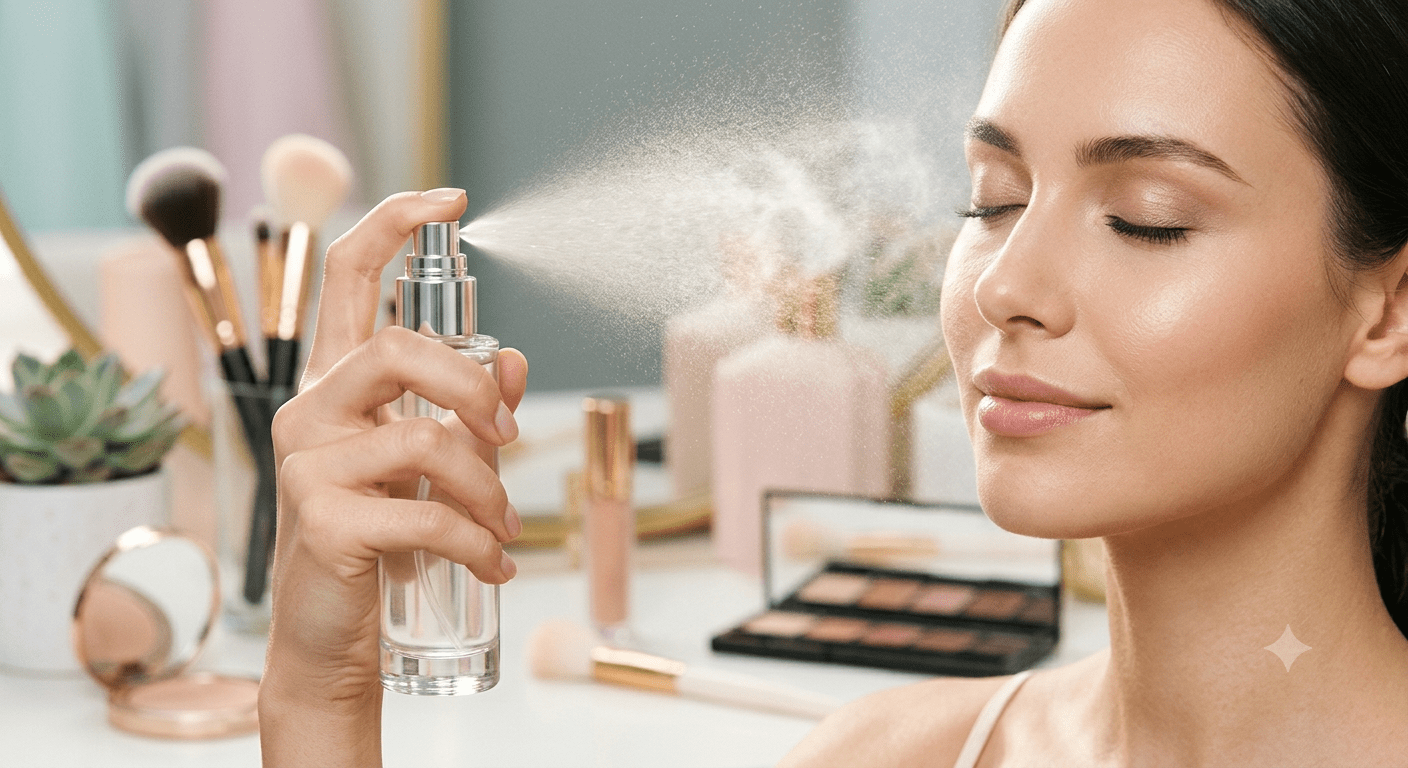
Hold the bottle 8 to 10 inches away from your face. Spraying too close drenches the skin, causing foundation to break apart into droplets and mascara to bleed.
4.Execute the ‘X’ and ‘T’ Pattern:Step 4.
Close your eyes and mouth. Mist across your face in an “X” motion, followed by a vertical and horizontal “T” motion. This guarantees full coverage across the perimeter and central features of the face in 4 to 5 light spritzes.
5.Let It Air-Dry Completely:Step 5.
Resist the urge to rub, pat, or fan aggressively. Allow the mist to evaporate naturally over 1 to 2 minutes so the film-forming barrier can set properly.
Pro Tricks: How to Use Setting Spray Beyond the Final Step
Professional makeup artists rarely reserve setting spray solely for the end of a routine. Here are four high-impact techniques to elevate your application:
The “Sandwich” Technique for All-Day Longevity
If you struggle with foundation breaking down around your nose or forehead, try layering your products:
- Spray a light layer of setting spray directly onto clean, primed skin.
- Apply your liquid foundation and concealer while the skin is slightly tacky.
- Lightly dust translucent powder over oil-prone zones.
- Finish with a final generous mist of setting spray.
This creates a dual-layer polymer sandwich that locks in color from both beneath and above.
Dampening Beauty Sponges
Instead of wetting your makeup sponge with plain tap water, saturate it with setting spray before bouncing liquid foundation or concealer onto the skin. This mixes the film-forming agents directly into the pigment, creating superior adhesion and an airbrushed finish.
Intensifying Eyeshadow and Highlighters
To turn a sheer shimmer or metallic eyeshadow into a foiled, high-impact pigment:
- Pick up the eyeshadow onto a flat synthetic brush.
- Spritz the brush head once with setting spray.
- Press the wet pigment onto your eyelid.
The liquid amplifies reflective shift and prevents fallout throughout the night.
Sheering Out Heavy Powders
If you accidentally over-powdered your facehttps://glowingcave.com/2026/07/16/the-ultimate-guide-to-makeup-foundation-how-to-choose-match-and-apply-like-a-pro/, don’t start over. A generous mist of a humectant-rich setting spray melts excess powder particles together, removing the chalky texture and restoring natural skin dimension.
Common Mistakes to Avoid
Even top-tier products underperform if applied incorrectly. Keep an eye out for these frequent mistakes:
- Spraying Too Close: Spritzing 2–3 inches away creates heavy liquid droplets that streak foundation and dissolve eye makeup.
- Opening Eyes Too Soon: Opening your eyes immediately after spraying can cause fine lines around the eyes to hold wet product, leading to creasing before it dries.
- Using Alcohol-Heavy Sprays Daily on Dry Skin: High-alcohol formulas work wonders for theatrical long-wear, but daily use on dry or compromised skin barriers can strip moisture over time.
- Skipping the Shake: Unshaken bottles can deliver uneven bursts of raw polymers or mattifying powders, leaving white specks across dark clothing or skin.
The Bottom Line
A quality setting spray is one of the most effective tools for maintaining fresh, sweat-proof, and transfer-resistant makeup. By matching the formula to your specific skin needs—whether that means an oil-absorbing matte mist or a soothing, dew-enhancing elixir—and using correct layering techniques, you can keep your makeup looking just as vibrant at midnight as it did at 8 AM.