Leg Day Workout: The Ultimate Guide to Build Mass and Strength
Never skip leg day. It is the golden rule of fitness, echoed in gyms around the world. Yet, for many, the prospect of lower body training brings a sense of dread. Leg workouts are notoriously grueling, demanding immense cardiovascular output, mental fortitude, and physical exertion. However, the benefits of building a powerful lower body extend far beyond aesthetics.
Your legs are the foundation of your body. They house the largest muscle groups, and training them effectively triggers a massive release of natural growth hormone and testosterone, promoting full-body muscle hypertrophy. Whether you are an athlete looking to improve your vertical jump, a powerlifter chasing a heavier squat, or simply someone who wants a balanced, athletic physique, a well-structured leg day is non-negotiable.
This comprehensive guide will break down everything you need to know to execute the ultimate leg day workout. We will cover lower body anatomy, the crucial warm-up, a meticulously programmed workout routinehttps://glowingcave.com/2026/07/12/the-ultimate-guide-to-building-a-sustainable-fitness-routine/, and the recovery strategies necessary to build serious lower body strength and size.
Understanding Lower Body Anatomy
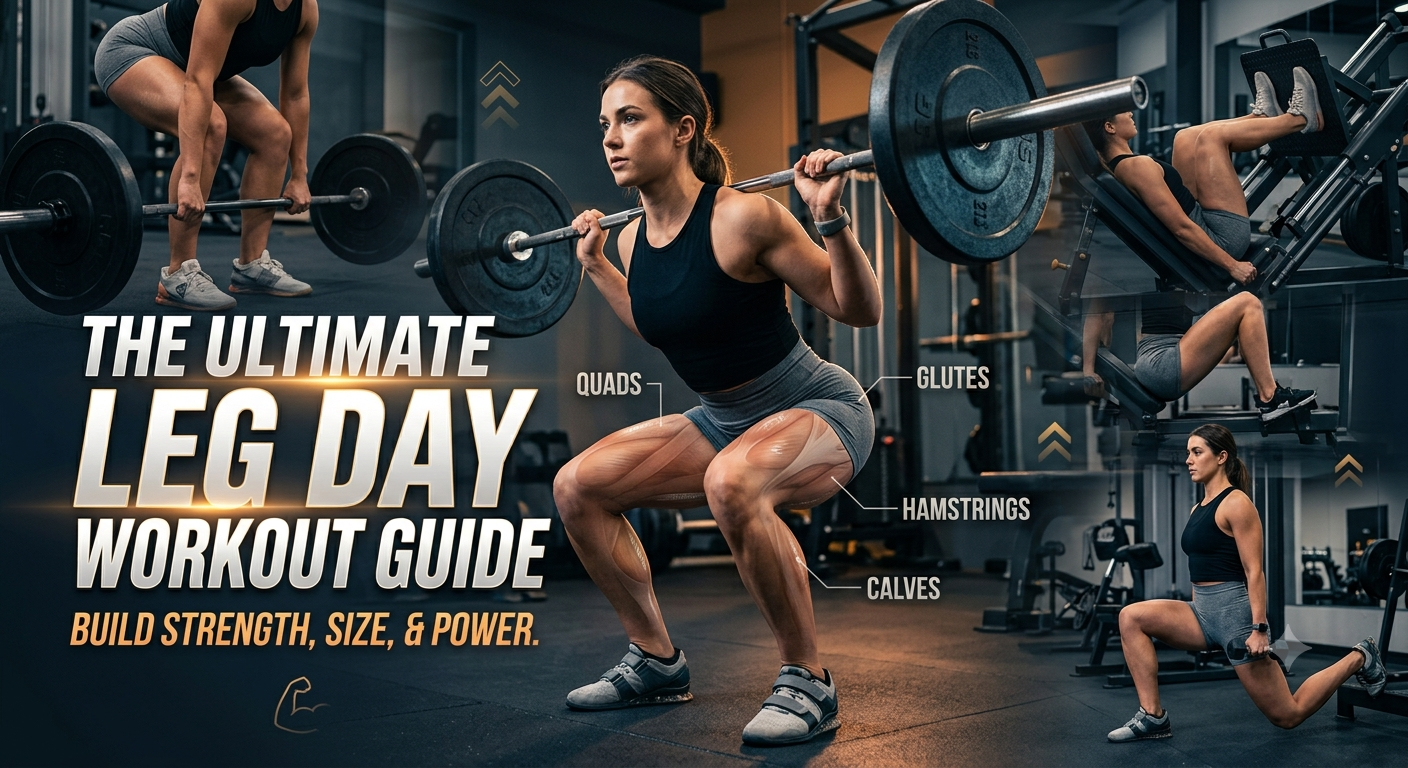
To train your legs effectively, you must first understand the muscle groups you are targeting. The lower body is complex, consisting of several major muscle groups that work in unison to perform pushing, pulling, and stabilizing movements.
The Quadriceps
Located on the front of your thighs, the quadriceps (often just called “quads”) are made up of four distinct muscle heads: the rectus femoris, vastus lateralis, vastus medialis, and vastus intermedius. The primary function of the quads is knee extension (straightening the leg). They are heavily engaged in movements like squats, lunges, and leg presses.
The Hamstrings
Situated on the back of your thighs, the hamstrings oppose the quadriceps. This muscle group includes the biceps femoris, semitendinosus, and semimembranosus. Their main functions are knee flexion (bending the knee) and hip extension (pushing the hips forward). Strong hamstrings are vital for athletic speed, explosive power, and knee joint stability.
The Glutes
Your gluteal muscles are the powerhouses of your lower body. The gluteus maximus is the largest muscle in the human body, responsible for powerful hip extensionhttps://www.muscleandstrength.com/workout-routines. The gluteus medius and minimus sit higher up on the pelvis and are crucial for hip abduction (moving the leg away from the centerline) and stabilization. Strong glutes protect your lower back and enhance almost every athletic movement.
The Calves
The calves are located on the back of the lower leg and consist of two main muscles: the gastrocnemius (the visible, diamond-shaped muscle) and the soleus (a flatter muscle lying underneath). They are responsible for plantar flexion (pointing the toes). Calves are notoriously stubborn to grow, requiring dedicated, high-volume training.
The Crucial Leg Day Warm-Up
Diving straight into heavy squats with cold muscles is a recipe for disaster. A proper warm-up increases blood flow, lubricates the joints, and prepares your central nervous system for the heavy lifting ahead. Spend 10 to 15 minutes on this routine before touching any weights.
- Light Cardio (5 Minutes): A brisk walk on a steep treadmill incline, a light cycle, or using the stair climber gets your heart rate up and pushes blood into your lower body.
- Dynamic Stretching (5 Minutes): Move your joints through their full range of motion. Perform leg swings (forward/backward and side-to-side), walking lunges, and high knees.
- Activation Exercises (5 Minutes): Wake up the specific muscles you are about to use. Glute bridges, monster walks with a resistance band, and bodyweight squats are excellent choices to “turn on” your mind-muscle connection.
The Ultimate Leg Day Workout Plan
This workout is designed to target every muscle in the lower body, utilizing a mix of heavy compound movements for strength and targeted isolation exercises for hypertrophy (muscle growth).
1. The Barbell Back Squat
The barbell back squat is universally recognized as the king of all exercises. It is a compound movement that heavily targets the quads, glutes, and hamstrings, while also requiring massive core stabilization.
- Sets and Reps: 4 sets of 5-8 reps.
- Rest: 2 to 3 minutes between sets.
- Execution: Position the barbell across your upper traps or rear delts. Unrack the weight, step back, and set your feet roughly shoulder-width apart with toes pointed slightly outward. Brace your core, keep your chest up, and push your hips back and down as if sitting in a chair. Descend until your hip crease is below your knee joint (or as low as your mobility allows without lower back rounding). Drive through your mid-foot to return to the starting position.
2. Romanian Deadlifts (RDLs)
While standard deadlifts are great, the Romanian Deadlift isolates the posterior chain (hamstrings and glutes) far more effectively, taking the quads out of the equation.
- Sets and Reps: 3 sets of 8-10 reps.
- Rest: 90 seconds to 2 minutes between sets.
- Execution: Hold a barbell or dumbbells with a shoulder-width grip. Stand tall with your feet hip-width apart. Keep a slight, soft bend in your knees (do not lock them out, but do not bend them further during the movement). Push your hips straight back while keeping the bar practically dragging down your thighs. Lower the weight until you feel a deep stretch in your hamstrings, keeping your back completely flat. Squeeze your glutes to drive your hips forward and return to the top.
3. The Leg Press
After taxing your central nervous system with squats and RDLs, the leg press allows you to push heavy volume into your quads and glutes without your lower back being the limiting factor.
- Sets and Reps: 3 sets of 10-15 reps.
- Rest: 90 seconds between sets.
- Execution: Sit in the machine and place your feet on the sled. A standard shoulder-width stance targets the overall leg, a lower stance emphasizes the quads, and a higher, wider stance emphasizes the glutes and hamstrings. Unlatch the safety, lower the weight under control until your knees are at a 90-degree angle, and press back up. Never fully lock your knees out at the top of the movement.
4. Bulgarian Split Squats
Unilateral (single-leg) training is essential for correcting muscle imbalances and improving athletic stability. The Bulgarian split squat is brutal, but incredibly effective for building the quads and glutes independently.
- Sets and Reps: 3 sets of 8-12 reps per leg.
- Rest: 60 to 90 seconds between legs.
- Execution: Stand a few feet in front of a bench. Reach one foot back and rest the top of your foot on the bench. Hold dumbbells in each hand. Keeping your torso upright, lower your body until your front thigh is parallel to the floor. Your back knee should hover just above the ground. Push through the heel of your front foot to stand back up.
5. Leg Extensions and Leg Curls (Superset)
Now it is time to isolate the individual muscles to ensure total fatigue. A superset involves performing two exercises back-to-back with no rest in between.
- Sets and Reps: 3 sets of 15 reps (Extensions), immediately followed by 15 reps (Curls).
- Rest: 60 seconds after completing both exercises.
- Execution: For leg extensions, adjust the machine so the pad rests on your lower shins. Squeeze your quads to straighten your legs, pausing for a second at the top. For leg curls (seated or lying), ensure the pad is securely against your ankles and curl the weight toward your glutes, feeling the hard contraction in your hamstrings.
6. Standing Calf Raises
Do not treat calves as an afterthought. They require high tension and a full range of motion to grow.
- Sets and Reps: 4 sets of 15-20 reps.
- Rest: 60 seconds between sets.
- Execution: Use a standing calf raise machine or a Smith machine with your toes elevated on a block. Drop your heels as low as they can comfortably go, feeling a deep stretch in the Achilles tendon and calf muscle. Explosively press up onto your tiptoes, squeezing the calves as hard as possible at the top for a full two seconds before lowering slowly.
Common Leg Day Mistakes to Avoid
Even with the perfect plan, poor execution can ruin your results and lead to injury. Avoid these common pitfalls:
- Knee Valgus (Knees Caving In): During squats and leg presses, your knees should track in line with your toes. If they collapse inward, you risk serious ligament damage. Focus on actively pushing your knees outward during the concentric (lifting) phase.
- Ego Lifting: Sacrificing form for the sake of moving more weight is the fastest route to a back injury. It is better to squat 135 pounds with perfect, deep form than 315 pounds with a quarter-range of motion and a rounded spine.
- Neglecting the Hamstrings: Many lifters are “quad dominant” because they prioritize squats and leg extensions while ignoring the back of their legs. Weak hamstrings heavily increase the risk of knee injuries and hamstring tears.
- Skipping the Cool Down: Walking out of the gym the second your last set finishes leaves lactic acid pooled in your legs. Taking 5 minutes to stretch your hip flexors, quads, and hamstrings will severely reduce Delayed Onset Muscle Soreness (DOMS).
Nutrition and Recovery for Maximum Growth
You do not build muscle in the gym; you break it down. Muscle growth happens while you are resting and recovering.
Protein Intake: To repair the micro-tears created during a heavy leg session, your body needs adequate protein. Aim for roughly 0.8 to 1 gram of protein per pound of body weight daily. Lean meats, eggs, dairy, and high-quality protein powders are essential.
Carbohydrates: Leg workouts deplete your glycogen stores rapidly. Consuming complex carbohydrates (like oats, sweet potatoes, and brown rice) ensures you have the energy to push through the workout, and eating carbs post-workout shuttles nutrients into the muscles for recovery.
Sleep: This is the ultimate performance enhancer. Aim for 7 to 9 hours of quality sleep per night. During deep sleep, your body releases human growth hormone (HGH), which is critical for tissue repair.