

The Silent Shift in Fat Loss: Why Modern Peptides Are Outperforming Traditional Diets
For decades, the standard path to weight loss remained rigidly unchanged: eat less, move more, and rely on sheer willpower. Yet, despite millions adhering to calorie-restricted plans and grueling exercise routines, long-term weight loss maintenance remains notoriously elusive.
The primary barrier is not a lack of effort, but a physiological reality. When calorie intake drops, the human body activates protective evolutionary mechanisms. Metabolism slows, hunger hormones surge, and the brain generates an intrusive, constant psychological craving commonly referred to as “food noise.”
Recent developments in metabolic medicine have shifted this dynamic. The rise of therapeutic peptides—precise amino acid chains designed to communicate with cell receptors—has introduced a targeted approach to fat loss. Rather than attempting to override metabolic signals through restriction alone, peptides work directly with the body’s internal signaling pathways to regulate appetite, enhance insulin sensitivity, and optimize fat utilization.
What Are Peptides and How Do They Drive Weight Loss?
Peptides are naturally occurring, short chains of amino acids linked by peptide bonds. They act as biological signaling molecules, instructing organs, glands, and tissues on how to perform specific biological processes.
While the human body naturally synthesizes thousands of distinct peptides, therapeutic peptide science uses engineered analogs that mimic or enhance natural metabolic hormones. In the context of weight management and body composition, weight loss peptides influence metabolic function through several primary pathways:
- Satiety and Central Nervous System Signaling: Peptides act on key receptors in the brain’s hypothalamus to suppress appetite, signal fullness, and quiet intrusive thoughts about food.
- Delayed Gastric Emptying: By slowing the speed at which food exits the stomach, peptides prolong physical fullness after meals, reducing overall caloric intake naturally.
- Insulin Secretion and Sensitivity: Incretin-mimicking peptides optimize blood sugar regulation by stimulating insulin release in response to meals while reducing glucagon spikes, preventing the severe blood sugar crashes that trigger intense sugar cravings.
- Lipolysis and Mitochondrial Function: Specific peptide classes directly target adipose (fat) tissue, accelerating the breakdown of stored triglycerides into usable fatty acids and boosting cellular energy expenditure.
The Incretin Class: The Front-Runners of Peptide Weight Loss
The most extensively researched and clinically validated peptides for weight loss belong to the incretin mimetic family. Incretins are gut hormones released naturally after eating that play a crucial role in metabolic signaling.
1. Single Agonists: Semaglutide (GLP-1)
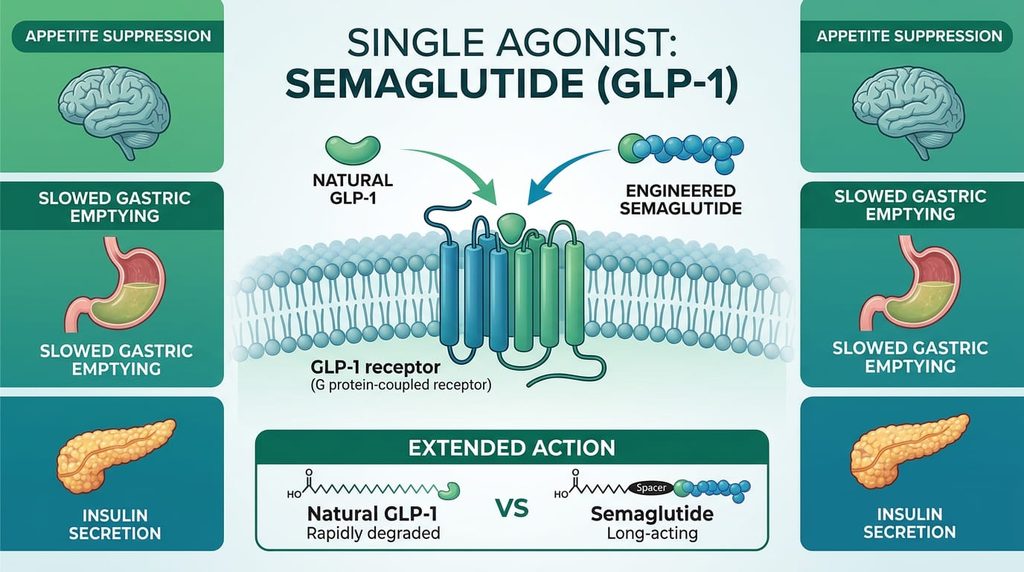
Semaglutide represents the foundation of modern metabolic peptide therapy. Functioning as a Glucagon-Like Peptide-1 (GLP-1) receptor agonist, it binds to GLP-1 receptors in the gut and brain.
- Primary Mechanism: Mimics endogenous GLP-1 to increase satiety, slow gastric motility, and reduce central appetite signals.
- Clinical Impact: Pivotal clinical trials demonstrate that weekly administration of GLP-1 agonists leads to an average body weight reduction of approximately 15% over 68 weeks when paired with basic lifestyle changes.
- Key Benefit: Strong safety track record and demonstrated cardiovascular protective properties alongside significant fat reduction.
2. Dual Agonists: Tirzepatide (GLP-1 / GIP)

Tirzepatide advanced peptide science by targeting two distinct receptor pathways simultaneously: GLP-1 and Glucose-dependent Insulinotropic Polypeptide (GIP).
- Primary Mechanism: Combining GIP receptor activation with GLP-1 agonism enhances insulin secretion and improves how fat cells (adipocytes) store and process lipids.
- Clinical Impact: Head-to-head clinical data shows dual-agonist therapy consistently outperforms single-receptor GLP-1 agents, with high-dose regimens yielding average weight reductions exceeding 20% to 22%.
- Key Benefit: Higher average weight loss and improved metabolic flexibility compared to single-agonist options.
3. Triple Agonists: Retatrutide (GLP-1 / GIP / Glucagon)
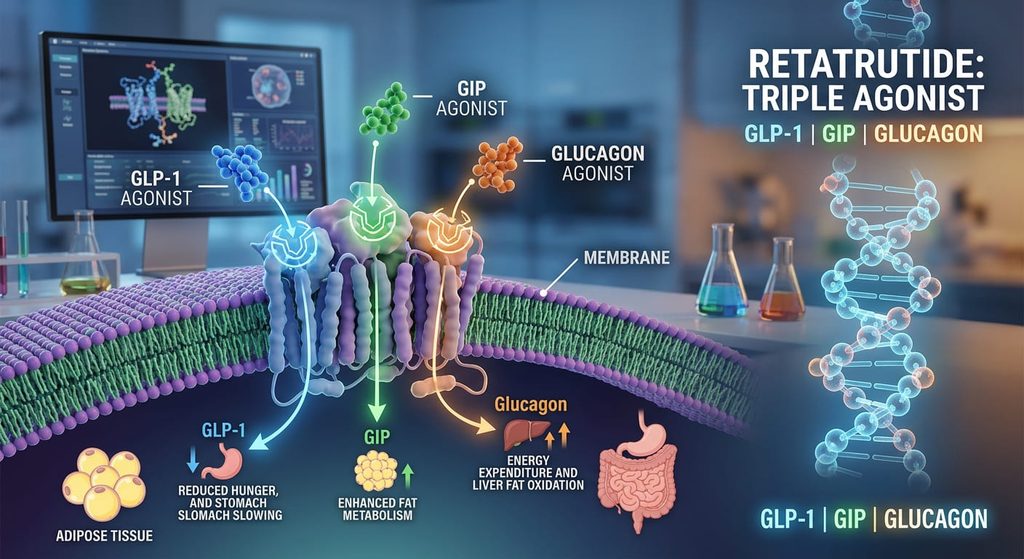
As the next evolution in metabolic peptide therapy, triple agonists target three separate receptors: GLP-1, GIP, and Glucagon (GCGR).
- Primary Mechanism: While GLP-1 and GIP suppress appetite and regulate blood glucose, the addition of glucagon receptor activation increases basal metabolic rate, energy expenditure, and liver fat clearance.
- Clinical Impact: Phase 2 and 3 clinical data for retatrutide have demonstrated unprecedented average weight reductions approaching 24% to 28%.
- Key Benefit: Directly increases metabolic rate and energy expenditure while maintaining strong appetite suppression.
Alternative and Complementary Weight Loss Peptides
While incretin mimetics lead the market in overall weight reduction, other specialized peptides are frequently studied for targeted fat loss, body composition optimization, and visceral fat reduction.
| Peptide | Primary Target | Key Mechanism | Best Known For |
| Semaglutide | GLP-1 Receptors | Satiety, delayed gastric emptying, blood sugar control | Overall fat loss and proven safety record |
| Tirzepatide | GLP-1 & GIP Receptors | Satiety, enhanced lipid metabolism, insulin sensitivity | High-potency weight loss and fat reduction |
| Retatrutide | GLP-1, GIP & Glucagon | Appetite control, insulin optimization, increased energy expenditure | Maximum weight reduction and metabolic acceleration |
| AOD-9604 | Adipose Tissue | Fragment of Growth Hormone; stimulates lipolysis without affecting blood sugar | Target fat reduction without growth hormone side effects |
| Tesamorelin | Pituitary Gland | Growth Hormone-Releasing Hormone (GHRH) analog; triggers natural GH release | Specific reduction of deep abdominal (visceral) fat |
| MOTS-c | Cellular Mitochondria | Mitochondrial-derived peptide; regulates metabolic homeostasis | Enhancing exercise capacity and insulin sensitivity |
Growth Hormone Fragments & Secretagogues
Peptides such as AOD-9604 and Tesamorelin offer a different pathway toward fat loss. Rather than acting primarily on satiety signals in the brain, these compounds interact with growth hormone pathways:
- AOD-9604: Derived from the C-terminal region of human growth hormone (hGH), this peptide was designed specifically to isolate the fat-burning (lipolytic) properties of growth hormone without inducing insulin resistance or affecting IGF-1 levels.
- Tesamorelin: An FDA-approved GHRH analog clinically proven to significantly reduce visceral adipose tissue—the harmful, deep abdominal fat that surrounds internal organs—making it particularly valuable for cardiovascular and metabolic risk reduction.
Peptides vs. Traditional Diets: The Physiological Advantage
To understand why peptides have changed the approach to weight loss, it is helpful to examine how the body responds to standard caloric restriction versus peptide-assisted weight loss:
[ Traditional Caloric Restriction ]
   │
   ├──> Decreased Caloric Intake
   ├──> Elevated Ghrelin (Hunger) & "Food Noise"
   ├──> Decreased Metabolic Rate (Adaptive Thermogenesis)
   └──> Result: Frequent Plateau, High Regain Rate

[ Targeted Peptide Therapy ]
   │
   ├──> Modulated Incretin / Receptor Signaling
   ├──> Natural Appetite Reduction & Caloric Deficit
   ├──> Stabilized Blood Glucose & Insulin Sensitivity
   └──> Result: Sustained Fat Loss with Preserved Energy
Traditional calorie restriction causes the body to defend its weight set point by producing more ghrelin (the hunger hormone) and reducing resting energy expenditure. In contrast, peptide therapies alter these biological signals, creating a sustainable caloric deficit while maintaining steady blood sugar levels.
Optimizing Results: The Role of Body Composition and Nutrition
While peptides are remarkably effective tools, maximum long-term success depends on how treatment is managed. Rapid weight loss carries the risk of losing muscle tissue (lean body mass) alongside body fat. Preserving muscle is critical because skeletal muscle drives baseline metabolic rate and physical function.
Strategies to Protect Lean Muscle Mass:
- Prioritize Protein Intake: Consuming adequate dietary protein (typically 0.8 to 1.0 grams per pound of target body weight daily) ensures necessary amino acids are available for muscle repair and maintenance.
- Incorporate Resistance Training: Engaging in regular strength training twice to four times weekly provides the mechanical stimulus required to preserve skeletal muscle tissue during an active caloric deficit.
- Structured Titration Schedules: Gradual escalation of peptide dosages helps minimize gastrointestinal side effects and prevents overly rapid weight loss that can accelerate lean tissue loss.
- Hydration and Micronutrient Support: Because reduced food intake automatically lowers overall fluid and nutrient intake, maintaining hydration and supplementing key vitamins is essential for cellular health.
Safety, Side Effects, and Medical Supervision
While modern weight loss peptides show strong safety profiles across vast clinical trials, they are active pharmaceutical agents that require proper medical evaluation and oversight.
Common Side Effects
The most frequent side effects associated with incretin-based mimetics are gastrointestinal in nature, particularly during the initial dosing and dose-escalation phases:
- Mild to moderate nausea
- Delayed digestion leading to feelings of over-fullness
- Changes in bowel habits (constipation or diarrhea)
- Transient fatigue or mild acid reflux
These symptoms typically resolve as the body adapts to the medication. Working alongside a qualified healthcare provider ensures proper dosing protocols, mitigating side effects while maximizing long-term fat loss outcomes.
The Future of Peptide-Based Weight Loss
Weight loss peptide science continues to advance rapidly. The landscape is shifting from single-target therapies to multi-receptor agonists, oral delivery formulations, and targeted organ-specific peptides.
By addressing the biological drivers of hunger, metabolic slowdown, and cellular energy expenditure, peptide therapies provide a scientific approach to body composition and long-term metabolic health. When integrated with solid nutritional habits, adequate resistance training, and proper medical guidance, peptides offer a sustainable strategy for shedding stubborn fat and maintaining metabolic control.