The Ultimate Guide to Fat Burning Cardio: Science-Backed Workouts for Maximum Fat Loss
The Science of Fat-Burning Cardio: How to Maximize Fat Loss Without Losing Muscle
Cardiovascular exercise remains one of the most effective tools for improving heart health, boosting stamina, and accelerating fat loss. However, walking into a gym or lacing up running shoes without a strategy often leads to plateaus, burnout, or loss of lean muscle mass.
To make cardio worhttps://www.hopkinsmedicine.org/health/wellness-and-prevention/8-ways-to-lose-belly-fat-and-live-a-healthier-lifek for you, it helps to understand the underlying physiology of fat loss, the difference between training modalities like High-Intensity Interval Training (HIIT) and Low-Intensity Steady State (LISS), and how to structure a routine that preserves muscle while maximizing caloric expenditure.
Understanding the Physiology of Fat Burning
When you engage in cardio, your body requires fuel to power working muscles. That fuel comes primarily from two sources: stored carbohydrates (glycogen) and stored body fat (adipose tissue).
Lipolysis and Fatty Acid Oxidation
Body fat cannot be burned instantly in its stored form. First, fat cells must undergo lipolysis, a process where triglycerides break down into glycerol and free fatty acids. These fatty acids enter the bloodstream and travel to the mitochondria (“powerhouses”) of your muscle cells, where they undergo beta-oxidation to generate adenosine triphosphate (ATP), the body’s primary energy currency.
The “Fat-Burning Zone” Myth
You may have seen “Fat Burn” modes on treadmills or ellipticals. This setting relies on the physiological fact that at lower intensities (around 60–70% of your maximum heart rate), fat accounts for a higher percentage of calories burned compared to carbohydrates.
Target Heart Rate Zones for Exercise. Source: Medical News Today
Key Takeaway: Lower-intensity cardio burns a higher percentage of fat, but higher-intensity exercise burns a greater total quantity of calories and overall fat per minute. Total energy expenditure (caloric deficit) remains the primary driver of body fat loss over time.
Calculating Your Target Heart Rate Zones
To optimize your cardio sessionshttps://glowingcave.com/2026/07/21/ultimate-gym-essentials-guide-what-to-pack-in-your-gym-bag-for-peak-performance/, calculate your maximum heart rate (MHR) and target exercise zones using a simple formula:
Estimated MHR=220−Age
For example, a 30-year-old individual has an estimated MHR of 220−30=190 bpm (beats per minute).
| Zone | Intensity (% MHR) | Primary Fuel Source | Best Used For |
|---|---|---|---|
| Zone 1: Warm-up / Active Recovery | 50% – 60% | Fat | Recovery days, warm-ups |
| Zone 2: Endurance & Fat Oxidation | 60% – 70% | Fat (higher ratio) | Long steady-state sessions, base building |
| Zone 3: Aerobic / Tempo | 70% – 80% | Carbs & Fat | Cardiovascular conditioning |
| Zone 4: Anaerobic Threshold | 80% – 90% | Carbs | High-intensity intervals (HIIT) |
| Zone 5: Maximum Effort | 90% – 100% | Phosphagen / Carbs | Short sprints, peak power output |
HIIT vs. LISS: Choosing the Right Approach
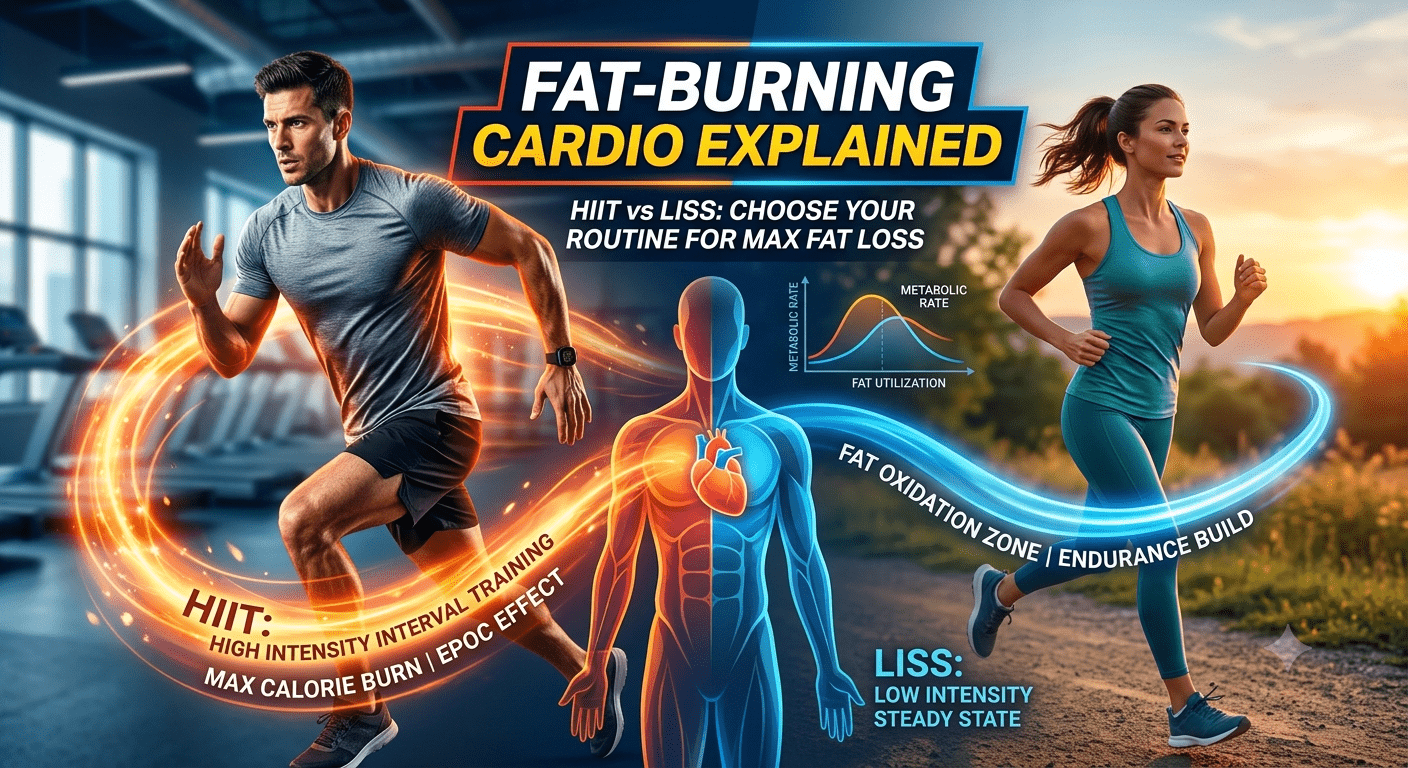
Two primary styles dominate fat-burning cardio protocols: High-Intensity Interval Training (HIIT) and Low-Intensity Steady State (LISS). Both offer distinct physiological benefits.
       [ HIGH INTENSITY INTERVAL TRAINING (HIIT) ]
       - Short duration (15–25 mins)
       - Alternates maximum effort & brief rest
       - High EPOC ("afterburn effect")
       - Requires higher recovery demand

                           VS.

       [ LOW INTENSITY STEADY STATE (LISS) ]
       - Longer duration (30–60 mins)
       - Maintained moderate intensity (Zone 2)
       - Minimal impact on central nervous system
       - Preserves muscle & easy to recover from
1. High-Intensity Interval Training (HIIT)
HIIT involves short bursts of maximum effort (85–95% MHR) followed by brief periods of rest or low-intensity recovery.
- Excess Post-Exercise Oxygen Consumption (EPOC): After intense bouts, the body consumes extra oxygen to restore ATP stores, clear lactic acid, and lower core temperature. This “afterburn effect” keeps your metabolic rate elevated for hours after the workout ends.
- Time Efficiency: A typical HIIT session takes only 15 to 20 minutes, making it ideal for busy schedules.
- Muscular Engagement: Explosive movements engage fast-twitch muscle fibers, helping to maintain lean mass during a diet phase.
2. Low-Intensity Steady State (LISS)
LISS involves maintaining a consistent, manageable effort (Zone 2, roughly 60–70% MHR) for an extended period, such as 30 to 60 minutes.
- Lower Recovery Demand: LISS puts minimal stress on the central nervous system (CNS) and joint tissues, allowing you to perform it frequently without interfering with heavy strength training.
- High Fat Utilization: Because intensity remains low and aerobic, oxygen is plentiful, allowing fat to serve as the dominant fuel source during the activity.
- Accessibility: It is safe and accessible for beginners, older adults, or anyone recovering from intense resistance training.
Which Is Better for Fat Loss?
Neither modality is superior in absolute terms; they serve different purposes. Research consistently shows that when total weekly caloric expenditure is matched, HIIT and LISS produce nearly identical body fat reduction. The best routine often combines both: 1–2 short HIIT sessions for efficiency and conditioning, plus 2–3 LISS sessions for sustainable calorie burn and active recovery.
Top 6 Exercises for Fat-Burning Cardio
Not all cardio exercises are created equal. The most effective options recruit large muscle groups and allow for adjustable intensity.
1. Incline Treadmill Walking
- Type: LISS
- Why it works: Walking at a steep incline (10–15%) significantly increases heart rate and glute/hamstring engagement without the joint impact of running.
- Sample Protocol: 30 minutes at 3.0–3.5 mph at a 12% incline.
2. Sprint Interval Training (Track or Exercise Bike)
- Type: HIIT
- Why it works: Maximum effort sprinting recruits maximal muscle mass and triggers high growth hormone release alongside significant EPOC.
- Sample Protocol: 8–10 cycles of 20 seconds all-out sprint followed by 40 seconds of slow walking or light pedaling.
3. Rowing Machine (Ergometer)
- Type: HIIT or LISS
- Why it works: Rowing engages around 86% of the body’s muscle mass—including legs, core, back, and arms—making it an exceptional total-body burner.
- Sample Protocol: 500-meter sprint intervals with 90 seconds of light rowing between sets.
4. Jump Rope
- Type: Moderate-to-High Intensity
- Why it works: High caloric burn per minute that improves agility, footwork, calf endurance, and shoulder stability.
- Sample Protocol: 1 minute of fast jumping followed by 30 seconds of rest, repeated for 15–20 rounds.
5. Stationary Bike / Airdyne Bike
- Type: HIIT or LISS
- Why it works: Fan bikes (Airdyne/Echo) push back harder the faster you pedal, forcing both upper and lower body to work simultaneously with zero impact on knees.
- Sample Protocol: 30 seconds max output / 30 seconds slow pedaling for 15 minutes.
6. Kettlebell Swings
- Type: High-Intensity Conditioning
- Why it works: Combines explosive posterior chain work (glutes, hamstrings, lower back) with elevated cardiovascular demand.
- Sample Protocol: EMOM (Every Minute on the Minute): Perform 15 kettlebell swings at the start of each minute for 15 minutes. Rest for the remainder of each minute.
Sample Weekly Fat-Loss Program
To maximize fat burning while preserving hard-earned muscle mass, pair your cardio routine with 3–4 days of resistance training.
Monday:    Upper Body Strength + 15-min LISS (Incline Walk)
Tuesday:   Lower Body Strength
Wednesday: 20-min HIIT Session (Rowing or Bike) + Core
Thursday:  Upper Body Hypertrophy + 15-min LISS
Friday:    Lower Body Hypertrophy
Saturday:  45-min Outdoor LISS (Biking or Fast Walk)
Sunday:    Rest & Active Recovery (Light Stretching/Walking)
Essential Rules for Fat-Burning Success
1. Maintain a Caloric Deficit
No amount of cardio can outrun an unmanaged diet. Fat loss requires consuming fewer calories than your Total Daily Energy Expenditure (TDEE). Cardio serves as a multiplier to increase your energy output, making a moderate deficit easier to achieve.
2. Prioritize Protein Intake
When losing fat, your body risks breaking down muscle tissue for energy. Consuming 1.6 to 2.2 grams of protein per kilogram of body weight (0.7–1.0g per pound) daily protects lean mass, keeps you full, and increases the thermic effect of food (TEF).
3. Don’t Neglect Strength Training
Resistance training signals your body that muscle tissue is essential, forcing it to draw energy primarily from fat stores instead. A program composed only of cardio often leads to a “skinny-fat” physique (loss of both fat and muscle).
4. Track Your Metrics
Avoid relying solely on the calorie readouts on gym equipment, which often overestimate energy expenditure by 15–30%. Instead, monitor your target heart rate using a wearable tracker, keep logs of your workout duration, and track weekly weight trends and waist measurements.
5. Manage Stress and Sleep
Elevated cortisol levels from chronic stress and sleep deprivation impair fat loss, increase water retention, and raise cravings for ultra-processed foods. Aim for 7–9 hours of quality sleep per night to ensure proper recovery between intense cardio sessions.
Final Thoughts
Fat-burning cardio is not about exhausting yourself with hours of endless running. By combining structured High-Intensity Interval Training with gentle, consistent Low-Intensity Steady State cardio—supported by a moderate caloric deficit and strength training—you create an environment where body fat is oxidized efficiently, energy stays high, and muscle mass is preserved. Select 2–3 cardio methods you genuinely enjoy, keep your target heart rate in check, and stay consistent.